Ground Screw Foundations for West Midlands Sites, From Terraced Gardens to Industrial Units
Foundations that go in through made ground, tight entries and live commercial yards across Birmingham, Wolverhampton, Coventry, Solihull, Dudley, Walsall, West Bromwich and Sutton Coldfield.
Book a free West Midlands site surveyCovering All of West Midlands
What ground will we actually hit on a West Midlands site?
Across most of the conurbation, what people put on top of the geology matters more than the geology itself. Birmingham and Solihull sit largely on Triassic sandstone and Mercia Mudstone, the Black Country on the South Staffordshire coalfield with Silurian limestone at Dudley. Nearly everywhere, the first metre or two is made ground.
Made ground and fill on former industrial land
Two centuries of foundries, forges, brickworks, canals and railways left the West Midlands with a great deal of fill. Ash, clinker, slag, brick rubble and demolition arisings turn up across Smethwick, Oldbury, Tipton, Aston and the older parts of Wolverhampton and Coventry, sometimes several metres deep, and often varying within a single plot. It is not material you can design a shallow pad onto and expect an even settlement.
Screws are taken down through fill until they reach natural ground, and the resistance building as each one goes in shows where that boundary sits at that exact position. That gives a foundation that is founded consistently even when the top of the site is not. The commercial argument is just as strong: excavating fill on brownfield land means classifying it, testing it and paying to tip it. A screw install produces effectively no arisings, so there is nothing to characterise and nothing to remove. Our page on foundations for difficult ground goes further into how variable ground is handled.
Dudley, Walsall and the Black Country: coal measures and limestone
The South Staffordshire coalfield runs beneath much of the Black Country, and at Dudley the Silurian limestone was worked so extensively that the caverns and the Wren's Nest workings are now a nationally important geological site. The legacy is real: shallow workings, historic mine entries and locally unstable ground in defined parts of the borough.
This does not rule out a screw foundation, but it does mean the ground investigation leads and the foundation follows. Coal mining risk assessments are a routine part of development here, and where a report sets limits on depth or method we design the screw layout to suit rather than argue with it. For commercial schemes we provide structural calculations and load testing reports as standard, which is set out on our commercial ground screw services page.
Birmingham, Solihull and Sutton Coldfield: sandstone, clay and mature gardens
North Birmingham and Sutton Coldfield sit largely on Triassic sandstone, which gives free-draining, sandy ground. To the south and east the Mercia Mudstone is clay-rich and shrink-swell, and in the Victorian and Edwardian suburbs, Moseley, Kings Heath, Harborne and Edgbaston among them, that clay lies under gardens full of large mature trees.
Trees plus shrinkable clay is the classic reason domestic foundations get deeper and more expensive. A screw pile is still a pile, so the required depth comes from the ground and the trees, not from a rule of thumb, and we will not pretend otherwise. What changes is the size of the hole in the garden: no trench, no mini-digger, no barrowing spoil through the house, and far less disturbance within the root protection area of a tree you want to keep.
How do you install in a terraced garden with no rear access?
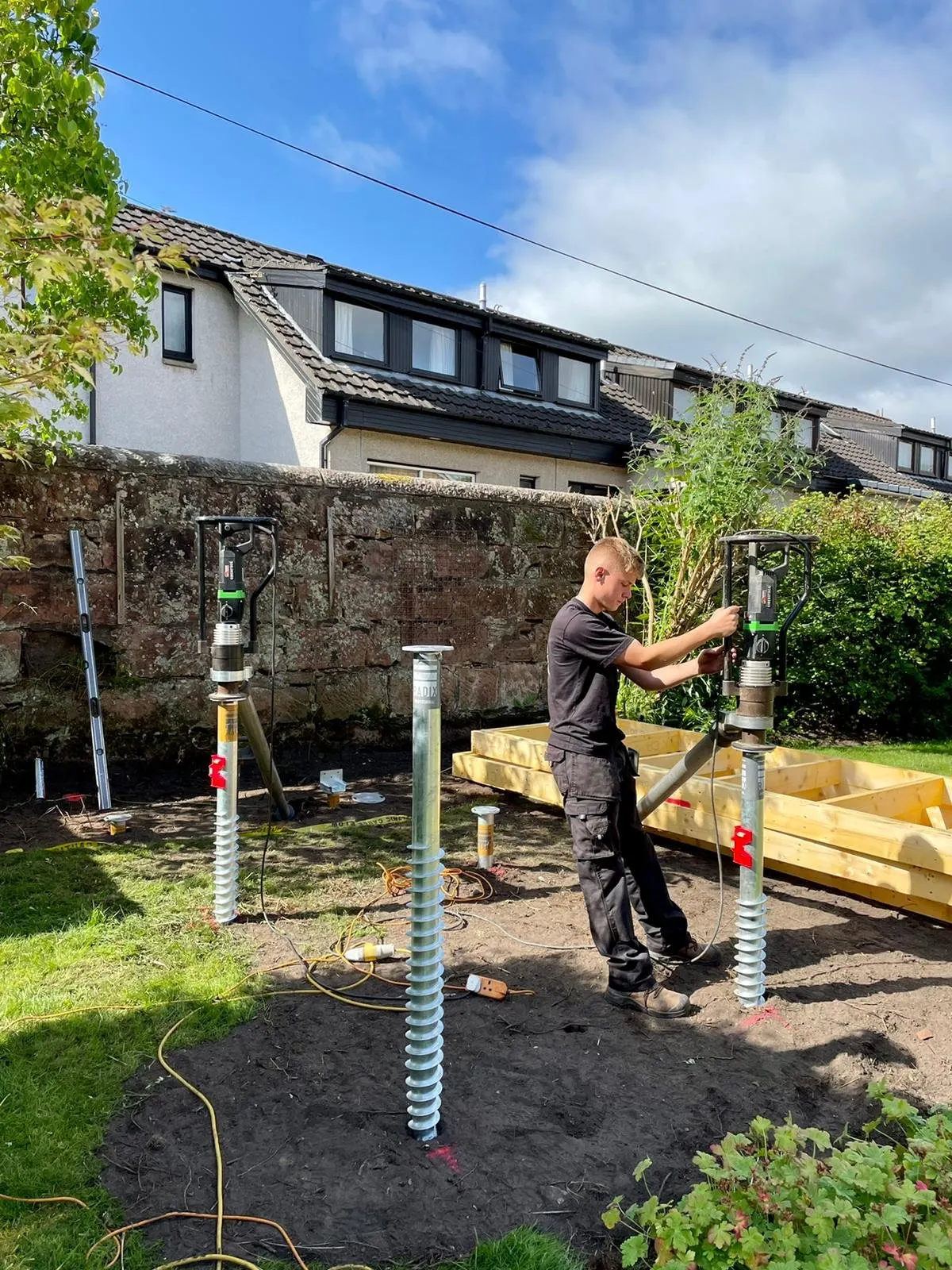
Everything comes in by hand. The equipment breaks down small enough to carry through a hallway, along the shared entry between a pair of terraces, or through a standard side gate. There is no concrete lorry, no pump line, no skip and no spoil, so nothing needs a wide route in or out.
The West Midlands street pattern is unusually hostile to traditional foundations. Long runs of terraces with no rear access, entries barely wider than a wheelbarrow, back gardens reached only through the house, and streets where the neighbouring properties are close enough that a week of breaking out and pouring becomes everyone's problem. Add resident permit zones across inner Birmingham, Coventry and Wolverhampton, and the logistics of a concrete pour start to cost more than the concrete.
Vehicle access is worth planning around too. Birmingham operates a Clean Air Zone covering the city centre inside the A4540 Middleway, charging non-compliant vehicles daily. A job that needs repeated wagon movements into that area is a very different proposition from one that needs a single van for a day. And because nothing sits on the public highway, there is no skip permit or highway licence to arrange with the council. For the tightest sites, see foundations for restricted access sites.
Neighbour disruption is the other half of it. Screws are turned in hydraulically rather than driven, so there is no percussive hammering and none of the vibration associated with driven piles. Most domestic installs are finished within a day, and the building can go up straight afterwards because there is nothing curing.
How does a ground screw foundation compare with concrete on a city site?
On an urban plot the comparison is rarely about the foundation itself. It is about spoil you have to test and tip, wagon movements through residential streets, road space you have to licence, and the days lost waiting for a slab to cure before anything can be built on it.
Strip out those four and a lot of West Midlands projects change shape. A screw foundation is ready to take load the moment the last screw is in, which on a commercial programme means the modules, the frame or the steel can land the same day rather than the following week. On a contaminated or made-ground plot, generating no excavation arisings removes an entire cost line and an entire risk.
The screws are galvanised steel, carry a 35-year structural guarantee and have an expected service life in the region of 60 years depending on ground conditions. They are also fully reversible, which matters more here than in most places because so much West Midlands commercial space is leasehold. The full side-by-side is on our ground screws versus concrete comparison, and the method is explained on the ground screw foundations page.
Who buys ground screws in the West Midlands?
The region has one of the densest concentrations of industrial estates and business parks in the country, so commercial work is a large and growing share of it. Alongside that sits a steady stream of domestic work in suburbs where getting a digger into the back garden is simply not possible.
Commercial, industrial and infrastructure
On industrial estates from Aston and Tyseley through to Darlaston, Oldbury and the Coventry ring, ground screws are used for storage and workshop buildings, external plant and generator bases, canopies, gantries, signage and security fencing, and for site welfare and portable accommodation that has to be level and load-bearing on day one.
Modular and offsite building suppliers are a natural fit, because a screw foundation can be set to millimetre tolerance and is ready the moment the unit arrives. So are solar and battery storage installers, where high pull-out resistance and fast, repeatable installation across an array are what count. And on leasehold sites, a foundation that can be unwound at the end of a term rather than broken out is a straightforward answer to a dilapidations clause. Phased works help too: screws go in inside a small compound without closing the yard to concrete wagons.
Commercial ground screw servicesHomeowners, landlords and small developers
Domestic demand here is driven by access rather than by slopes. Garden offices and studios in Moseley, Harborne, Solihull and Sutton Coldfield, decking and hot tub bases in long narrow suburban plots, and single-storey timber-framed additions on properties where the only route to the back garden runs through the hall. That covers garden room foundations, decking foundations and timber-frame extension foundations.
Landlords and small developers use them on infill plots and former garden land, where the plot is often awkward, the ground is often fill, and the neighbours are always close. A one-day, spoil-free install keeps a small site from becoming a nuisance to an entire street.
Domestic ground screw servicesWhich West Midlands areas do we cover?
The whole metropolitan county, across all seven boroughs. That means Birmingham, Wolverhampton, Coventry, Solihull, Dudley, Walsall and Sandwell, plus every town and suburb inside them.
- Birmingham
- Wolverhampton
- Coventry
- Solihull
- Dudley
- Walsall
- West Bromwich
- Sutton Coldfield
- Stourbridge
- Halesowen
- Smethwick
- Oldbury
- Tipton
- Willenhall
- Sedgley
- Kingswinford
We are based in Shrewsbury and also cover Shropshire, Staffordshire, Worcestershire, Cheshire and Powys. The full list is on our where we work page, and you can read what customers have said about the work on our customer reviews page.
West Midlands Ground Screws FAQs
Do you install ground screws in Birmingham?
Can you get equipment into a terraced back garden with no rear access?
Will ground screws work in made ground on a former industrial site?
What about Dudley and the Black Country, where there are old mine workings?
Is there noise, vibration or mess for the neighbours?
Do you need a skip or road space outside my house?
Can you build near mature trees in a Birmingham conservation area?
Do you take on commercial work on West Midlands industrial estates?
Can the foundation be removed at the end of a lease?
How quickly can you get to a Coventry or Wolverhampton site?
Get a fixed-price quote for your West Midlands project
Tell us where the site is, what is going on top and how we get to it. We will look at the access and the ground ourselves, then come back with a fixed-price quote within 48 hours. No obligation, and a real person on the end of the phone if you would rather talk it through.
- Domestic and commercial work across all seven West Midlands boroughs
- No skip, no concrete lorry and no road space needed
- Free site survey, then a fixed-price quote within 48 hours
Get a free West Midlands quote
No obligation • We reply within one working day