Ground Screw Foundations Across Shropshire, From Farm Tracks to Business Parks
Concrete-free foundations for commercial, agricultural and domestic projects in Shrewsbury, Telford, Oswestry, Ludlow, Bridgnorth, Market Drayton, Whitchurch and Newport.
Book a free Shropshire site surveyCovering All of Shropshire
What ground conditions do you find in Shropshire?
Shropshire has some of the most varied geology of any English county. In one working week you can move from glacial till and peat in the north, to Severn valley alluvium and red sandstone around Shrewsbury and Bridgnorth, to Mercia Mudstone and old coal workings around Telford, to shallow Silurian rock in the south. No single foundation depth suits all of it.
North Shropshire: glacial till, sand pockets and peat
Around Whitchurch, Market Drayton, Wem and Ellesmere the ground is largely what the last ice sheet left behind: stiff boulder clay, with lenses of sand and gravel that appear and disappear across a single plot, and deep peat close to the meres and mosses. The water table is often high and near-surface strength can be poor.
This is difficult ground to design a shallow pad onto with confidence, because the softness is not uniform. A screw is turned in until it meets resistance, so it finds the competent layer wherever that layer happens to be, and where the soft material is deep the screw is extended to get through it. Nothing is dug out, which matters on land where the arisings from a trench would be wet clay you then have to store or pay to remove. There is more on this in our guide to foundations for difficult ground.
The Severn valley and Shrewsbury: alluvium over sandstone
Shrewsbury sits inside a loop of the Severn, and the low ground either side of the river through the town, out towards Atcham and down to Bridgnorth, is alluvial: silts, sands and gravels laid down by the river, with groundwater that rises and falls with it. Away from the floodplain the underlying rock is Permian and Triassic sandstone, soft enough to work but a genuine change in what a screw meets at depth.
Riverside and floodplain plots are the worst possible place for an open excavation. You are pumping, the sides want to come in, and the spoil is saturated. Screws are installed into wet ground without any of that, and because the finished foundation is a set of steel points rather than a solid slab, it suits raised structures that sit clear of the ground.
Telford, Newport and the east: Mercia Mudstone and the old coalfield
East Shropshire is Mercia Mudstone country, and much of Telford sits over the historic Telford and Coalbrookdale coalfield. That gives two practical realities. Mudstone is a clay-rich, shrink-swell material, so moisture and nearby trees genuinely change what a foundation has to do. And after a century and a half of mining, brickmaking and ironworking, the top couple of metres across parts of Telford is made ground that varies plot by plot.
Coal mining risk assessments and ground investigations are a routine part of development here, and we do not attempt to shortcut them. Where a report sets constraints, the screw type, length and layout are designed to suit it. Load testing and structural calculations are provided as part of the package on commercial ground screw installations.
South Shropshire: shallow rock at Ludlow, Bridgnorth and the hills
South of Church Stretton the Silurian mudstones, siltstones and limestones around Ludlow and Craven Arms sit close to the surface, and hillside plots frequently have thin soil over rock. Bridgnorth is the opposite problem in the same county: the town is cut into soft red sandstone, which is why it has cliff-side cave dwellings and a funicular railway.
Shallow rockhead does not stop a screw foundation, but it changes the design. It usually means shorter screws in greater number to spread the load, and occasionally pre-drilling to get a clean start. That is a judgement made on site at survey, not a number pulled off a table.
How do Shropshire ground conditions change the screws we use?
They change length, diameter, count and layout. Because a screw is turned into the ground rather than poured into a hole, the resistance it meets on the way down tells us what is actually there. Each screw is set to its own depth, so a foundation can be level across ground that is anything but.
On glacial till in the north we expect to go deeper to get past soft or variable material. On thin soil over rock in the south we expect the opposite. On a floodplain we are looking for the gravel horizon. That variability is the whole argument for surveying the site rather than quoting from a postcode, and it is why every Shropshire job starts with a free survey and a fixed-price quote within 48 hours.
The screws themselves are galvanised steel and carry a 35-year structural guarantee, with an expected service life in the region of 60 years depending on ground conditions. They are also fully reversible, which is a real consideration on tenanted farm land, rented yards and anything consented on a temporary basis. If you want the direct comparison against a traditional base, we have set it out in detail on ground screws versus concrete foundations, and the method itself is explained on our ground screw foundations page.
Can you reach rural Shropshire sites with no hardstanding?
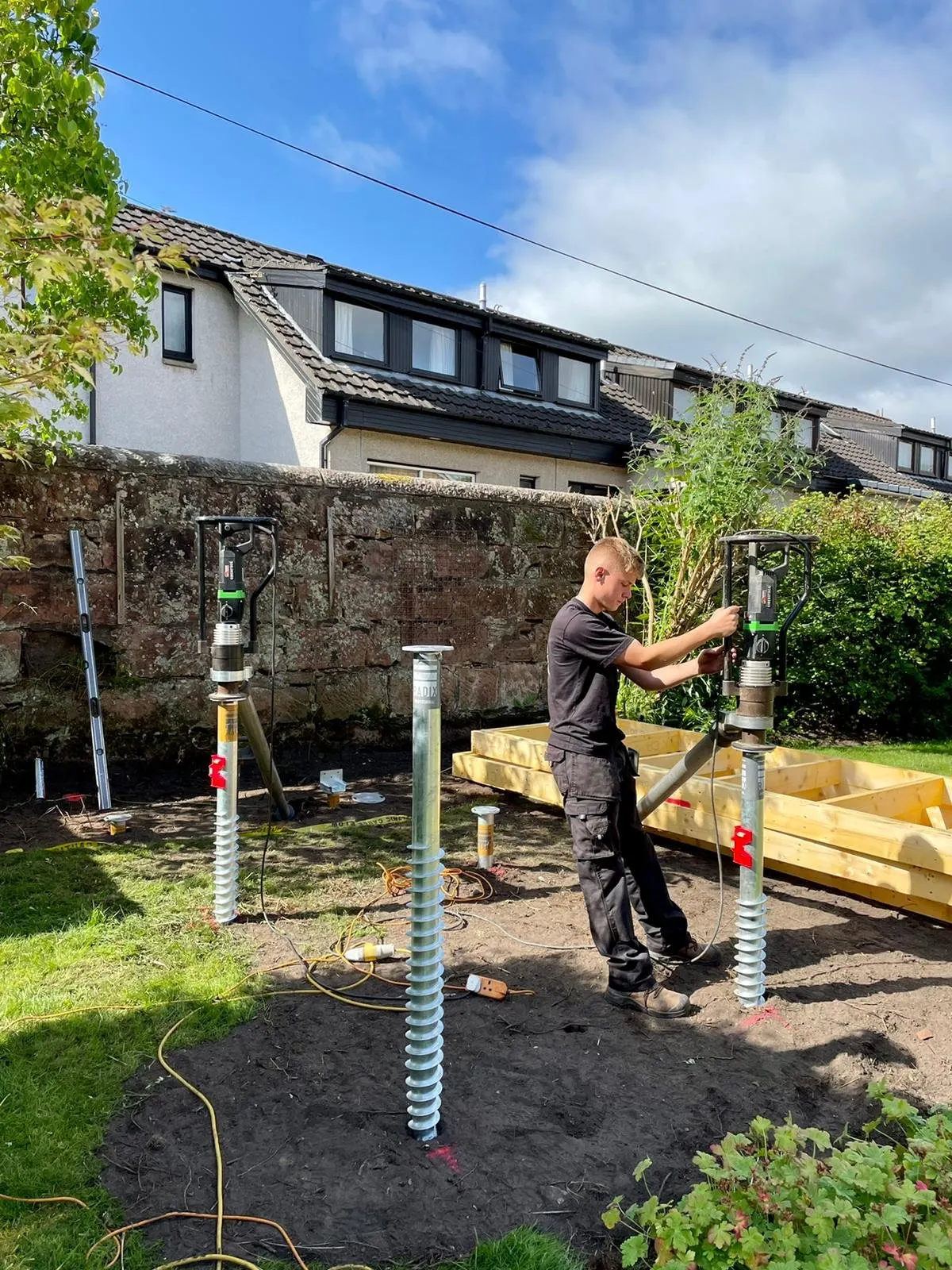
Yes. Access is the reason a lot of Shropshire projects end up on screws in the first place. A ready-mix lorry needs a firm surface, turning space and a route an eight-wheeler can physically take. Our equipment is compact, needs no water or power on site, and travels in a van.
This county is full of sites that defeat concrete on logistics alone: single-track lanes with passing places out towards Bishop's Castle and Clun, half-mile unmade drives, field gateways sized for a tractor rather than a wagon, and yards where you cannot block the only route in for half a day. Add a wet fortnight and an unsurfaced track becomes impassable to anything heavy long before it becomes impassable to us.
The other half of the problem is what a concrete pour leaves behind. Excavation on a working farm means spoil to move, ruts across grazing and a plant route that has to be reinstated. A screw install generates effectively no arisings, so the ground either side of the foundation is left as we found it. For genuinely constrained plots, including sites where everything has to be carried in by hand, see foundations for restricted access sites.
Who uses ground screws in Shropshire?
Two very different groups, for overlapping reasons. Commercial and agricultural clients want speed, no curing time and a foundation they can unbolt later. Homeowners want a level base put in without a fortnight of skips, mixers and churned-up garden. The technique is the same; the specification is not.
Commercial, industrial and agricultural
Shropshire has a substantial industrial base for a rural county: the estates around Telford at Stafford Park and Halesfield, Battlefield and Harlescott on the edge of Shrewsbury, and a long list of smaller units and yards spread through Oswestry, Whitchurch and Market Drayton. On sites like these, screws are used for storage and workshop buildings, welfare and site accommodation, plant and generator bases, canopies, signage and security fencing.
We also work for modular and offsite building suppliers, who need a foundation that is level to the millimetre and ready to receive a unit the moment it arrives, and for solar and battery storage installers, where high pull-out resistance and rapid, repeatable installation across a large array matter more than anything else. On the agricultural side the same method suits machinery stores, livestock shelters, feed and grain buildings, and the growing number of farm diversification projects across the county.
Commercial ground screw servicesHomeowners and self-builders
Domestic work in Shropshire is dominated by sloping and awkward gardens. A level platform over a fall of half a metre or more is straightforward with screws and expensive with concrete, because concrete needs either terracing or a lot of imported fill. That covers garden room and home office bases, decking foundations on hillside plots, hot tub bases carrying heavy point loads, and timber-framed extension and annexe foundations.
The second driver is disruption. Most domestic installs are done in a single day, with no excavation, no spoil in the drive and no waiting for a slab to cure before the building can go up. In village lanes and terraces around Ludlow, Much Wenlock or Bridgnorth, where there is nowhere to put a skip, that difference decides the job.
Domestic ground screw servicesWhich Shropshire towns do we cover?
All of them. We are based in Shrewsbury and work across the whole county, from Whitchurch and Market Drayton in the north to Ludlow and Cleobury Mortimer in the south, and out to Oswestry and the Welsh border.
- Shrewsbury
- Telford
- Oswestry
- Ludlow
- Bridgnorth
- Market Drayton
- Whitchurch
- Newport
- Wem
- Church Stretton
- Craven Arms
- Much Wenlock
- Shifnal
- Ellesmere
- Broseley
- Cleobury Mortimer
We also cross the county boundary regularly into Powys, Cheshire, Staffordshire, Worcestershire and the West Midlands. You can see the full picture on our where we work page, and what Shropshire customers have said about the work on our customer reviews page.
Shropshire Ground Screws FAQs
Do ground screws work in Shropshire clay and glacial till?
Can you install on a Shropshire farm with no hardstanding or track?
Are ground screws suitable near the River Severn or on a floodplain plot?
Do you install in Telford, where there are old coal workings?
Will ground screws work on a sloping site around Church Stretton or Ludlow?
Do I need planning permission for a ground screw foundation in Shropshire?
Can you work in a Shrewsbury conservation area or close to protected trees?
Do you install through a Shropshire winter, or do we wait for dry weather?
Can ground screws be taken out again if the building is temporary?
How far across Shropshire do you travel, and is the survey free?
Get a fixed-price quote for your Shropshire site
Tell us where the site is and what is going on top of it. We will assess the ground and access ourselves, then come back with a fixed-price quote within 48 hours. No obligation, and a real person on the end of the phone if you would rather talk it through.
- Shrewsbury based, covering the whole of Shropshire
- Free site survey, then a fixed-price quote within 48 hours
- Installed year round, including wet and frozen ground
Get a free Shropshire quote
No obligation • We reply within one working day